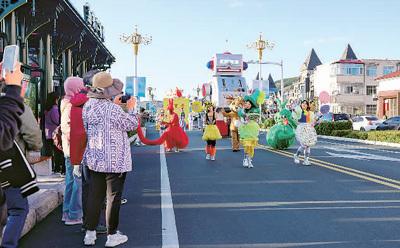
It snows in Chengdu today! Netizen: Scalp snow, it is also snow.


The 6th CBSA Chinese Billiards World Championship ended the men’s team final on the afternoon of 16th. In the confrontation between two young players from China after 00, Zhao Ruliang beat Shen Shenyi 41-28, winning the men’s team championship in the Chinese Billiards World Championship for the first time.

The men’s team of the Chinese Billiards World Championships is strong, and none of the top 16 professional men of the Chinese Billiards Association is absent. The famous British Eipl, Shi Hanqing, john young and Zheng Yubo all appeared in the competition.
As the last runner-up, Zhao Ruliang was recognized as one of the favourites to win the championship before the competition. In the double-losing stage, Zhao Ruliang won Grain Rain Peng, Suniri and Lei Yiwei in a row, and advanced from the winning department to the top 32. In the single defeat stage, Zhao Ruliang stood out and eliminated Dai Yong, Chu Bingjie, Xu Xiaoying and john young successively, and entered the final.
Shen Shenyi, born in 2004, has risen rapidly in Chinese billiards in recent years, and entered the tournament directly as a seed player. In the single defeat stage, Shen Shenyi beat Eipl, narrowly beat American star Zhang Ronglin, beat Niu Zhuang in the quarter-final, and beat dark horse Xu Tianwei in the semi-final, and reached the final of the World Championships for the first time in his career.
In the third stage of the men’s final, Zhao Ruliang, who is more experienced in the competition, played a small climax at the last minute to determine the obvious lead. In the fourth stage, he won four games in a row, and then won 41-28 in the third match point, winning the championship prize of 3 million yuan (RMB, the same below).
The 6th CBSA Chinese Billiards World Championship is divided into men’s group and women’s group. In the women’s group competition that ended before, Tang Chunxiao beat Liu Xiazhi 19-9 to win the championship.
CBSA Chinese Billiards World Championship, initiated by China Billiards Association in 2015, is the largest and highest-level Chinese billiards tournament in the world, which also accelerates the internationalization of Chinese billiards. A total of 496 players from 41 countries and regions participated in this tournament, and the scale of participation reached a new high, with a total prize money of 10.43 million yuan. (Reporter Jiang Tao)


Unconsciously, the 8-day Spring Festival holiday is coming to an end, and I have to go to work for 6 days in the first week after the holiday. After going to work on Sunday, February 18th, there will be another Monday. According to the Notice of General Office of the State Council on Some Holiday Arrangements in 2024, the holiday date of this year’s Spring Festival is: February 10th to 17th, with a total of 8 days. Go to work on February 4 (Sunday) and February 18 (Sunday). It is reported that the working day in 2023 is 249 days, and the working day in 2024 is 251 days. This year, I have to go to work for 2 days more than last year.

On the morning of June 22nd, "Beautiful Hebei Red Line — — A delegation from the online media interview activities to commemorate the 95th anniversary of the founding of the Party came to Qiannanyu Village, Jiangshui Town, Xingtai County, Hebei Province. The picture shows the Kangda Exhibition Hall.
Hebei News Network (Reporter Chang Fangyuan) This is a fertile red soil and the greenest place in Taihang Mountain. The development model of "red+green" has turned into the badlands into a green mountain and a barren mountain ditch into an economic ditch. On the morning of June 22nd, "Beautiful Hebei Red Line — — The delegation of the online media interview activities to commemorate the 95th anniversary of the founding of the Party came to Qiannanyu Village, Jiangshui Town, Xingtai County, Hebei Province. The beautiful and rich Qiannanyu made online media reporters praise it.
Qiannanyu is the seat of China People’s Anti-Japanese Military and Political University (hereinafter referred to as "Anti-Japanese University"). On November 4, 1940, Kangda General School was stationed in Jiangshui, Xingtai County, Hebei Province. Since then, it has been running here for three years, and has trained three students, totaling 18,000. Zhu De, Peng Dehuai, Liu Bocheng, Deng Xiaoping, Luo Ruiqing, Teng Daiyuan, He Changgong and other proletarian revolutionaries of the older generation have fought and lived here.
On the morning of June 22nd, "Beautiful Hebei Red Line — — A delegation from the online media interview activities to commemorate the 95th anniversary of the founding of the Party came to Qiannanyu Village, Jiangshui Town, Xingtai County, Hebei Province. The picture shows online media reporters interviewing in Qiannanyu Eco-tourism Zone.
Came to Qiannanyu, "Beautiful Hebei Red Line — — In commemoration of the 95th anniversary of the founding of the People’s Republic of China, the interview group first visited the Kangda Exhibition Hall. Surrounded by green hills and shaded by green trees, the Kangda Exhibition Hall is magnificent and solemn. "Looking at today’s magnificent buildings, it’s hard to imagine the hard conditions here in the past. I wanted to look for the old site of Kangda just now, but I was told by the commentator that there was no remains of the old site of Kangda, because the school building of Kangda in the war years was just a few dilapidated earth-walled grass houses. More often, teachers and students could only struggle and study on the grass and in the ravine. " After the visit, Jing Wong, a reporter from overseas network, felt that in the extremely cruel and arduous war years, groups of anti-big students took up important posts, made outstanding contributions to winning the victory of War of Resistance against Japanese Aggression and even the war of liberation, and showed the revolutionary ancestors’ spirit of hard struggle and the greatness of firm revolutionary belief.

On the morning of June 22nd, "Beautiful Hebei Red Line — — A delegation from the online media interview activities to commemorate the 95th anniversary of the founding of the Party came to Qiannanyu Village, Jiangshui Town, Xingtai County, Hebei Province. The picture shows the scenery of Qiannanyu Village.
Starting from Kangda Exhibition Hall, take a battery car all the way up Panshan Road, and you will come to the entrance of Qiannanyu Eco-tourism Zone. What you see along the road are clean houses with red roofs and white walls, clear streams flowing down, and apple orchards full of fruits … … Entering the tourist area, the terraced fruit trees surrounded by layers of stones are lush, and an asphalt road winds up and shuttles through the intoxicating green. On the hillside, the six characters of "recreating beautiful mountains and rivers" planted by evergreen shrubs stand out against the blue sky and white clouds.
Guo Tianlin, secretary of the Party Committee of Qiannanyu Village, said that Qiannanyu was not the scene before. Qiannanyu, which suffered nine disasters in ten years, was a well-known poor mountain village. In 1963, a catastrophic flood almost destroyed all the mountain vegetation and only a few hundred acres of life-saving fields in the village. Since then, Qiannanyu people have been managing mountains and controlling water for 20 years before they got this piece of green in Taihang Mountain. Today, Qiannanyu has formed a layered greening model of barren hills with "ecological forest wearing a hat, dried fruits wrapped around the waist and small terraces holding the foot". All 8300 mu of barren hills suitable for forest in the village have been afforested, with the forest coverage rate exceeding 90% and the vegetation coverage rate approaching 95%.
More than a decade ago, Qiannanyu people made up their minds to close down polluting enterprises such as mineral processing plants and chemical plants that could bring them considerable economic benefits, and developed a 38-square-kilometer "red" and "green" combined eco-tourism zone by using anti-big red resources and green resources all over the mountain, which received nearly 500,000 tourists in 2015. Forest fruit planting and tourism development, before 2015, the collective income of Nanyu Village was 31.2 million yuan, and the per capita income reached 11,800 yuan.
"Here, the spirit of hard struggle not only stayed in the war years, but is still being carried forward. The beautiful scenery here is not a gift from nature, but comes from people’s efforts. What is even more rare is that a group of scientific and technological leaders like Li Baoguo have emerged here, who can take root in places with difficult conditions and lead farmers to develop. " Dai Yu, a reporter from the People’s Daily Central Kitchen, lamented that in Qiannanyu, the red spirit collided with the green beauty, and Taihang Mountain was being written as a legend.
Come to New Year this year.
In addition to friends and family.
There is also a cold wave from the polar regions.
Central Meteorological Observatory at 06: 00 on January 23
Continue to issue a cold wave blue warning
It is expected that it will not be until the third day
This cold wave will continue to affect our country.
Affected by strong cold air, it is estimated that the temperature will drop by 6 ~ 10℃ in most parts of central and eastern China, by 12~14℃ in eastern Northeast China, eastern Jiangnan and northeastern South China, and by more than 16℃ in eastern Jilin from 08: 00 on January 23rd to 08: 00 on January 25th. There are 4 ~ 6 winds in the above areas, and gusts are 7 ~ 8. Some areas in western Gansu, western Inner Mongolia, northern Qinghai and Ningxia have sand or floating dust. There are 6 ~ 8 winds and 9~10 gusts in most offshore areas of China. The lowest temperature in the process appeared on the morning of 25th, and the lowest temperature 0℃ line will be located in the east of Yunnan, south of Guizhou and north of South China.

From 23rd to 24th (the second day and the third day of New Year’s Day), the temperatures in Northeast China, North China and East China will hit new lows after winter, and the temperature will be 6-10℃ lower than normal.
From the early morning of January 23rd, snowflakes began to float in Zhangjiakou, Chengde, Tangshan, Qinhuangdao, Baoding and many places in Beijing.
[Snow in xiong’an new area]


Address: xiong’an new area Yuerong Park Source: Jishi Client
[Snow in Tangshan]


Photo from Tangshan traffic police
Hebei specific weather forecast
[Hebei Meteorological Observatory continued to issue the blue warning signal of cold wave at 05: 00 on January 23, 2023]
Affected by cold air, it is expected that the lowest temperature in the whole province will continue to drop tomorrow morning, with Baoding, Langfang and the south area dropping by 6 ~ 8℃, local dropping by 8 ~ 10℃ and other areas dropping by 2 ~ 5℃. Tomorrow morning, the minimum temperature in the north of Zhangjiakou and Chengde will drop to-33 ~-26℃, in Shijiazhuang, Cangzhou and the south, to-16 ~-12℃, and in other areas to-25 ~-17℃.
[Hebei Meteorological Observatory continued to issue gale blue warning signal at 05: 00 on January 23, 2023]
Affected by cold air, it is expected that there will be winds of 4 to 6 from north to northeast in eastern Chengde, Qinhuangdao, eastern Tangshan, Cangzhou, Hengshui, Xingtai and Handan from day to night, with gusts of 7, which will weaken to below 6 at night; There are 4 to 6 northwest winds, 7 gusts and 8 local gusts in Zhangjiakou, the central and western Chengde, the western Baoding and the western Shijiazhuang. There are 7-8 northeast winds, 9 gusts, 6-7 northwest winds and 8-9 gusts in coastal waters and coastal areas. Please take precautions!
[Weather forecast issued by Hebei Meteorological Observatory at 05: 00 on January 23, 2023]
Today, from day to night, scattered light snow or light snow turned cloudy in southern Langfang, Cangzhou, eastern Hengshui, western Shijiazhuang and western Xingtai, while other areas turned cloudy and sunny. The highest temperature is-25 ~-5℃ in Zhangjiakou, Chengde, Tangshan, Qinhuangdao and northwest Baoding, and-4 ~ 2℃ in other areas. The lowest temperature is-33 ~-20℃ in Zhangjiakou, Chengde, northern Qinhuangdao and northwestern Baoding, among which-33 ~-26℃ in Bashang area and-19 ~-12℃ in other areas.
Tomorrow, from day to night, the whole province will be sunny and cloudy.
From day to night on the 25th, the northwest turned sunny and cloudy, while other areas were cloudy and sunny.
Yesterday (22nd, New Year’s Day),
The cold wave brings strong winds and cools down to "celebrate the New Year"!
Today and tomorrow,
On the 23rd (the second day) and 24th (the third day),
The temperature in our province plummeted,
Many places will be frozen.
And the strong wind "assisted",
The wind-cold effect is remarkable,
Little friends, be sure to wear more clothes to protect yourself.


To sum up
During the Spring Festival this year
The cold in the north lasts for a long time
It’s short but really cold in the south.
Everyone should pay attention to cold and warmth.
Synthesis: Website of Central Meteorological Observatory, Hebei Weather and Meteorology Beijing
]


Qilu Net Lightning News February 3 rd What do you think of winter in Shandong? It is to climb the mountain to enjoy the snow and see the scenery wrapped in silver. It is to play with ice and snow and unlock the new gameplay in the winter fairy tale world; Or enjoy the folk customs in the countryside and feel the folk customs in winter … Follow Xiao Ni, the virtual anchor of Lightning News, and go to Shandong for the New Year together to get a close look at Qi Feng Lu Yun and friendly shandong.
editpersonaccording to
Examinations have always been the most worrying thing for students. For college students, the performance not only represents the academic level, but also is an important basis for future research or employment. In order to get satisfactory results, students not only hope that the teacher can "draw the key points", but also hope to be lenient when judging the papers … …
But for teachers, the mood when marking papers is by no means as simple as leaving no mercy. Recently, the reporter received a letter from a university professor, complaining about the "suffering" during the final exam. Although it has been a holiday, many jumps in the students’ papers, perfunctory answers, lackadaisical language expression, logical analysis, and even the "blank space" under the exam questions still make him sigh.
Is what the professor said a common phenomenon? What problems are mapped out in a paper? It’s the school season again, and I hope that this year’s questioners and respondents can make real efforts to complete a satisfactory answer sheet.
[Letters from readers]
Shock wave behind a final exam paper
Li Mingliang, Professor of International Business School of Tianjin Foreign Studies University.
I have been teaching in the university for more than ten years, and at the end of each semester, I will face a serious psychological shock — — Suffer from the "torment" of the final exam. This "suffering" is not only a physical test, but also a mental torture. At the end of almost every semester, I have to read at least 200 or 300 papers by myself. These "final exam works" from students of different majors and grades are not only hard to see refreshing, serious and beautiful writing, but also jump and answer casually, and the language expression and logical analysis are indifferent. There are even many papers that leave a lot of worrying blanks. A teacher once told me that some students couldn’t answer the questions, so they simply drew a smiling face in the blank space under the examination questions, and then wrote a kind word praising the teacher, as if to please the teacher or win the teacher’s sympathy, hoping that the teacher could be "merciful."
As we all know, examination has its unique functions of evaluation, detection, diagnosis, guidance, feedback and encouragement, which cannot be replaced by any other teaching link. The final exam is not only a final assessment and systematic evaluation of students’ learning situation of various courses since one semester, but also a process check of professional teachers’ teaching effect and teaching quality. Generally speaking, the total score of the current assessment courses in colleges and universities is comprehensively evaluated according to the usual scores and final exam scores. Among them, the usual scores include quizzes, homework, class discussions, course papers, attendance, etc. The final score is the final closed-book exam paper score, and their respective weights are different in each school. But on the whole, most colleges and universities stipulate that the final grade accounts for 50% ~ 70% of the total grade. In addition, some colleges and universities also stipulate that there should be no less than four kinds of questions in the final examination paper of each course, and the number of questions is moderate and the difficulty is moderate, which should basically ensure that candidates can complete it within 90 minutes. In this way, the test questions of many courses are limited to noun explanation questions, multiple-choice questions, fill-in-the-blank questions, short-answer questions, discussion questions, case analysis questions or calculation questions. Students also follow this logic year after year to review the "exam-oriented". In colleges and universities, there is also an unwritten "rules of the game". Teachers will divide the students into a general examination range at the end of the term to give each other a "reassurance". Otherwise, students will be at a loss and don’t know what to review;Teachers will also be worried that candidates will "fail in a large area" and the failure rate is too high, which will not only affect their personal teaching reputation, but also lead to tension between teachers and students; Seriously, it may also be held accountable by the teaching authorities, and even ultimately affect the annual performance appraisal and professional title promotion of teachers.
From this point of view, the curriculum assessment in our colleges and universities is really not limited to a final examination paper. This is not only related to the relationship between teachers and students, teaching, examination, evaluation and management in colleges and universities, but also related to the talent training mode of higher education, especially the quality of talent training. In fact, for many years, we have been advocating the separation of teaching and examination, calling for the separation of teaching and examination, and teachers do not participate in the final examination of their courses, including setting questions, invigilating, marking papers, scoring and quality analysis; Instead, a set of examination management system with complete rules and regulations including examination database, automatic proposition, marking, grading, examination analysis, score management and so on is established. College curriculum examination should not blindly emphasize theory over application, knowledge over ability, results over process and grades over feedback, but should be adjusted to pay more attention to students’ innovative ability and practical ability, and realize a comprehensive evaluation system with comprehensive evaluation contents, diversified subjects, diversified methods and dynamic process. However, in reality, colleges and universities still have a long way to go in order to build a scientific, comprehensive and reasonable evaluation system and its mode reform.
This holiday, Wang Li, a sophomore in a university in Shanxi, didn’t have an easy time. "There are two exam results that haven’t come out, and I’m particularly worried that I can’t pass them. Because I didn’t answer the last two big questions, my paper score is definitely not enough. I pray that the teacher can make my usual grades higher." For these two grades, Wang Li basically brushes the school website every day, and often chats with his classmates to "pray for blessings". "There are still a few days before school starts, and we will know the result soon."
Liu Zhengdong, Wang Li’s classmate, told the reporter, "I had a hunch that I would fail two exams, and finally I went to the teacher to plead with him, hoping that he would hand ‘ Song ’ Point, the final result is quite satisfactory, all 60 points, just passed. " Looking at the results haven’t come out yet, Liu Zhengdong advised Wang Li to send a message to the teacher and get in touch with "feelings", so maybe he could pass the exam on the line. "After all, many students didn’t answer well."
1. "Everything will be fine if you don’t fail."
Are the examination papers of college students really so casual and so "vulnerable"?
"No matter which school, there are schoolmasters, but to be honest, if there are no goals such as insurance research that explicitly require credit scores, many students are in line with ‘ Just pass the exam ’ The mentality to cope with the exam. I usually don’t listen to lectures in class, I leave homework from the Internet, review all night before the exam, and everything will be fine without failing. " Zhu Wenshuo, a college student in Beijing, told reporters.
"The examination questions of many courses are nothing more than noun explanation questions, multiple-choice questions, fill-in-the-blank questions, short-answer questions, essay questions and so on." Fan Hui, a college student in Hunan, is a liberal arts student. In his view, liberal arts exams are usually relatively easy. "As long as you can remember the knowledge points, you will definitely get similar results. Especially the following essay questions, as long as you have a general understanding of this course, you can write the paper full and make sense, and the basic score will not be bad. "
A college teacher who has been engaged in teaching for many years read this sentence repeatedly after seeing it. "I can’t say a lot, but there are some papers that have such problems. When students don’t know what to answer, they will simply list or analyze some concepts of this course, lack basic logic, and even answer irrelevant questions. Because the students know that as long as I answer this question, the teacher will give some points. "
However, there is also a college teacher who believes that the college exam is to condense the task of assessing students’ knowledge into a test paper. "Therefore, teachers often ask questions fairly well, and students only need to write out what they think is the most correct. We can’t ask all students to keep a cutting-edge and in-depth understanding of a certain knowledge."
2. Who is responsible for the "dull" test paper?
Then, in the face of some "plain" answers that are difficult to make people shine at the moment, we should think deeply. What is the problem?
In this regard, Mo Leiyu, an associate professor at China University of Mining and Technology (Beijing) School of Management, believes that there are three reasons: First, the academic level of students is uneven now, and it is difficult to unify the measurement standards; Second, due to the school regulations, some colleges and universities have specific proportions for the failure rate of course assessment; Third, under the baton of postgraduate entrance examination, students are utilitarian, and many students do not attach importance to courses that are not directly related to postgraduate entrance examination.
Chen Peng, director of the Department of Communication at Nankai University, said that sometimes, in order to "standardize" and facilitate management in a uniform way, educational management departments will require teachers to take exams according to certain prescribed formats, forms and even contents, sometimes they have formulated strict procedures for exams, and sometimes they even put forward some requirements for exam results. "For example, I have learned that the education management departments of many universities will require teachers to take exams in some form, which will facilitate the final filing management; Sometimes students’ grades are required to present an approximate normal distribution, otherwise they are considered to have problems in the exam; Sometimes teachers’ grades are questioned, and in order to be consistent with their standards, teachers are required to lower or raise their grades. In the final analysis, it is still to cope with teaching evaluation. " Chen Peng said, "As an important link in teaching, examination evaluation should respect the laws of education and teaching and be set by teachers, and should ensure that teachers are in the professional field according to professional standards, academic standards and teaching objectives ‘ Discretion ’ 。”
"Just because the test papers answered by students are relatively dull does not mean that there is something wrong with the test itself." Some experts said that examination may not be the best way to assess, but as far as the current situation is concerned, there is no better way to test learning, supervise learning and complete evaluation. He believes that the negative impact seen at present is by no means from the examination mechanism itself.
Chen Peng said: "Exams and grades are the intersection of students and teachers in knowledge dissemination. Different understanding of the role of knowledge in the educational process and life path leads to different understanding of exams between teachers and students and between different students. However, if there are courses, there will be exams, because every course needs quality evaluation and effect test, and it is necessary to innovate in ways and methods. "
3. How to get the true level in the exam?
Kun Wang, a student of a university in Beijing, was deeply impressed by a small innovation in an ordinary exam. She told reporters that in the final exam of English listening course last semester, in addition to the regular British accent, there was also a Japanese accent in her listening materials. "Although it is indeed difficult to distinguish, it is inevitable to encounter this kind of communication situation in practical application. After several years of professional courses, it is necessary for us to exercise our ability to eliminate all kinds of interference factors."
"We all know that exams are very important, but we often ignore the significance of exams." Kun Wang said that when we take exams just for the sake of exams, the effect will naturally be greatly reduced.
"The meaning of the exam is to know what progress students have made and what students have gained through the study of the course ‘ Value-added ’ , to what extent ‘ Value-added ’ ; Discover the shortcomings of students’ learning process and find out which aspects of students have failed to achieve the expected learning effect, so as to provide targeted and targeted help to students. " Professor Xie Xiaoqing, former director of beijing language and culture university Institute of Educational Measurement, said.
Then, how to make the exam play a greater role and make the exam get the true level?
In Mo Leiyu’s view, the examination can be analyzed in detail, such as dividing the examination into two parts, setting a unified national examination method for the basic knowledge part, and stipulating a bottom line that students of this major must reach. If it is not reached, the basic knowledge is not mastered. "Now there are many channels for students to acquire knowledge, but most of them are fragmented and difficult to connect, so it is still necessary to systematically examine the basic knowledge. Non-single answer questions involving creative and divergent thinking can be flexibly assessed by interviews and other means. "
Xie Xiaoqing emphasized: "The knowledge test mainly examines the memory of specific professional knowledge. This kind of memory knowledge can often be completed with the help of online search, which is easy to dampen students’ interest in learning. The ability test mainly examines those psychological characteristics that have a wide influence and are relatively stable. This kind of test has obvious effect on improving students’ overall quality. At the same time, the ability test is not easily affected by the surprise preparation, and can accurately reflect the students’ real learning level. "
(Our reporter Jin Haotian, our correspondent Jiang Jiaqian)